Matriarchalist Reading List
How to Start a Womencircle
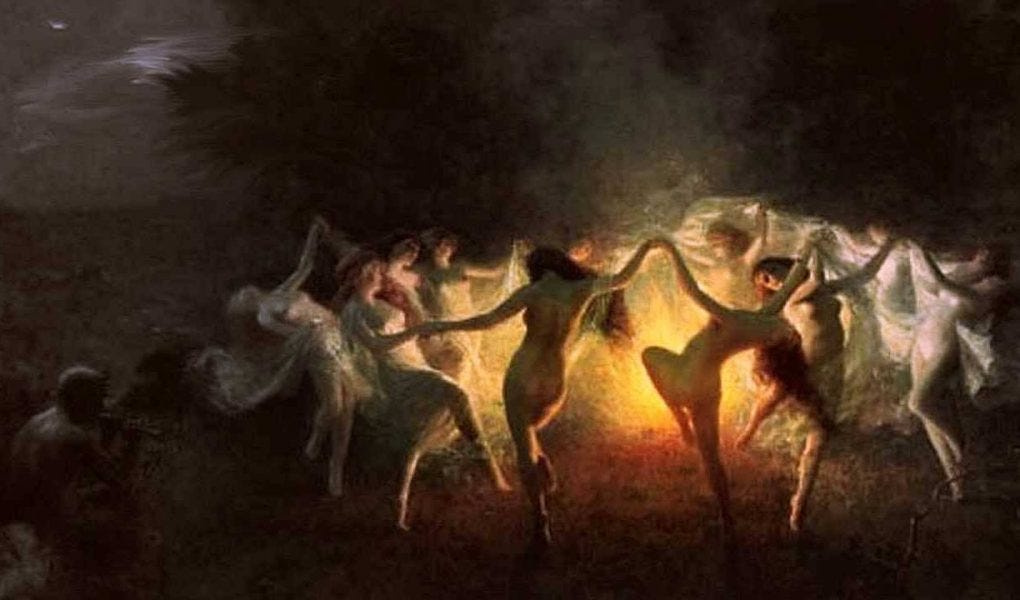
Gather in, sister, friend, mother,
Moving us, here with each other,
Weaving our loving together.
The covens where witches traditionally gather (related to the word “convent”) bear witness to witchcraft’s roots in early matrifocal societies and matrilineal families. Patriarchal societies are fueled, at their deepest root, by a fiendishly simple maneuver: separating women from each other. This separation wounds and weakens us in multiple vicious ways. We lose clarity in our thinking, joy and comfort in our hearts—and above all, we lose the spiritual compass of experiencing Goddessery in each other.
There is no aspect of the witch’s path, the Goddess-loving path, more central or more revolutionary than bringing a group of women, consciously and intentionally, together — especially for a spiritual purpose that does not involve serving a monotheistic male God! This is why Jean Shinoda Bolen, in her little book Sacred Circles, proposes that the simple act of women meeting in intimate circles is the most effective first step to healing the world from all that ails it.
And why not? How else could we possibly start?
A witch’s way has time-honored forms of gathering built into it: the circle and the coven. (BTW if you’re wondering about the relationship I see between witches and Goddess worshippers, it’s like a Venn diagram with considerable overlap in the middle. I’ll write more about this another time or as soon as someone asks me!).
Here I’ll share my experiences in two different kinds of womencircles, a coven and a sacred circle, and my best tips for starting your own. . .
Coven
A coven is a powerful working group of women who are highly motivated to create magical transformation in their own lives and in the world. Many witches have covens of 13 or more, but my best coven experiences have been in small
groups where there is plenty of time for everyone to go very deep, and it’s quick to reach consensus and easy to turn on a dime when we decide something.. I was in a fabulous coven for almost a decade when I lived in Maine. We met to mark the Wheel of the Year whenever possible. We were all working mothers,and we shared the same sense of witchcraft as a kind of folk magic that is resilient and flexible and ingenious and arises in the nooks and crannies of daily life.
One of my favorite things about being a witch (in addition to the dancing and singing!) is that witchery is —as we might expect of a women-centered spiritual path—a folk religion that arises within the interstices of daily life. We rarely “prepared” for our coven in any way that required time. But we prepared perfectly! We would open ourselves to happenstance and intuition and bring with us whatever we were called to bring —a plant or Goddess statue or snack associated with the Solstice or Equinox or Cross-quarter day we were honoring, and then what called us as needing spiritual attention— a photograph or a letter, a piece of lingerie, a .child’s toy We would eat together and share deeply, cast a circle with the 5 Directions, discuss some more, and then, as if of one mind, suddenly spiral into a profound magical healing process that had arisen out of the common ground we had uncovered—there was always a common ground.
I am still filled with awe to recall the ceremonies and ritruals we three would invent together, in a living room before the kids got home from school, in a backyard, on a little beach, in the snow. We marked, we honored, we commemorated, we exorcised. Twigs and stones and works of art and salad bowls and necklaces were our magical tools. The knowledge we had been gathering and reading and learning in our lives already was our sacred library. The intuition of our inner selves—along with the Goddessness we found in each other—was our spiritual authority.
And it worked. In all those years, I feel there was no issue we could not address, no transformation we could not help with.
Is it amazing that there was nothing special about us, either, really? We were open-hearted, open-minded, open-spirited, loving women, devoted to being the best friends and mothers and human beings we could possibly be— and eager to do pretty much anything it would take to get there.
We did share certain beliefs and patterns of action in our lives that opened us to magick: we had gone through trauma, done therapy and healing. We were comfortable asking for help and respectful of truth, even hard truth. But we had no particular spiritual training or knowledge besides what our natural curiosity had picked up.
In short, we were like so many, many,many amazing women I know.
And like so many other women, we felt the Goddessery in us. And among us. And in all the world around us. Sometimes we felt it so powerfully it was dizzying.
So, so beautiful. Liberating. Joyful.
There is nothing like a coven.
Sacred Circle
Whether or not you are part of a working coven, every witch can benefit from coming together with others in a supportive Sacred Circle. My circle fluctuates between six and nine women who gather about once a month for spiritual support and inspiration. Sometimes called a moonlodge, a circle like this is a place to share insights and techniques, compare notes, and support each other in our spiritual journeys and our wider lives. In my current circle, one woman works primarily with plants, one with yoga, one with crystals, one with chakras, one with ceremony, and one with homeopathic medicine. Our primary purpose is to support and grow with each other no matter where our paths lead.
Circle Structure
In our circle, we usually start by casting a Goddess Circle, purifying the space with smudging and/or sound, and making some kind of ceremonial music or chanting. Then we will pass a talking stick and share the stories of where our path has taken us since last time, alert to spiritual clues, common threads, and deeper connections. Sometimes one of us will share divination cards or another magical tool or we may do a shamanic journey, guided visualization, or special ritual together. We close with a simple chant and dance. But even if we only talk and support one another, the effect is to weave together our spiritual and daily lives in a way that is profoundly helpful.
How to Start a Circle
Start where you are. I remember craving a circle for several years before a friend and I finally started one. Now I don’t know why I waited so long. If you know one other person with a similar outlook who wants in, you’ll be on your way. It’s usually better to let the circle develop organically and slowly rather than rushing it. Once you start to meet regularly, new members will appear. If you make the effort to reach out to members from different cultures, sexualities (including transwomen), and ethnic and class backgrounds, this diversity of perspectives will prove a great asset for everyone in the circle down the road.
Develop ground rules. Decide whether you will always meet in one place or move around, how you will schedule your gatherings (once a month on a regular time such as the third Tuesday was what worked best for our circle), what your maximum size will be, if and when you will invite new members (to avoid disruptions, some groups have just one annual time when new members can join), how to handle reminders of meeting times (will one person be in charge of reminding others via text or email, or will this job circulate?), how you will pay for candles and other supplies or for the meeting space if needed (you could ask for dues, or simply leave out a donation basket), and whether you will have any formal “programming” (some circles ask a different member to prepare a short ritual or activity each time, while others, like mine, are more casual and leave it up to chance).
Mix it up To get to know each other in a different way and strengthen the group, it’s nice to schedule extra gatherings at different times and places than your usual meeting place a couple of times a year: a daylong special ceremony or weekend retreat, a lunch date, or a night out.
Use a talking charm A ceremonial object that is held by whoever is talking is a powerful tool for harmony in the circle. In Native American traditions this is often a “talking stick,” but any special object will do. In our circle we sometimes use a unique tree root, sometimes a heart-shaped rock. Pass the talking charm counterclockwise; anyone who is not ready to speak can pass it along. If you are ready to speak when it reaches you, hold the charm until you are finished and it will create a visual “safe space” in which you will not be interrupted. The charm can make the rounds several times so people can reply or speak again. Sometimes, if your circle agrees, people can ask to “borrow” the charm out of turn to add a quick comment. If the conversation becomes more general, you can just stop using it until someone wants to pick it up again.
Stay honest Sometimes a group can go through a “stale” period where people are afraid to say what’s on their minds. Maybe several people want the group to make some changes, and each person thinks they’re the only one. Be alert for such times and treat them as opportunities to break through the habits and become more authentic with each other. It can feel risky to be open about your critical or negative thoughts, but the payoff is worth it.
Take changes in stride. The witch Starhawk describes three stages in the life of a group: Forming, Storming, and Performing. During the Storming phase, after the honeymoon period is over, the group may readjust itself and some members may leave before things settle down. There’s no need to take any of this personally; it’s just as easy to take the long view and remember that a circle has its own dynamic that is bigger than any of the individual members.
Share your gratitude Once your circle is functioning, the odds are that it will become a precious addition to your life. If so, remember to share these positive feelings with the circle aloud when you’re together. Remind the others how much you appreciate the group, and bring chocolate sometimes. Like any relationship, a relationship with a Goddess Circle thrives with gratitude and appreciation.
Consider reaching out Does your circle have a wider role to play? There is witchy power and joy in supporting social and political movements that build community from shared values. Political action on behalf of the earth, for example, is a major part of the important witchy movement called Reclaiming. You could participate in marches, volunteer at soup kitchens, or host open, publicly advertised rituals to celebrate important times such as Samhain or Yule.
Some Useful Tools for Circle
South (Will, Creativity): Candles and Images
Candles in the colors of the Five Directions can be used to mark the directions of the circle, along with artwork showing Goddesses, animals, and other signs of the directions. it’s a nice reminder to keep all the Directions in mind.
East (Clarity, Commuication): Talking Piece
As each person speaks, she holds the talking piece, as a reminder to everyone that she has the floor. In my onw Goddess Raising Circles, we usually go around the circle at least 3 times counterclockwise (widdershins). I think of this as a kind of “stirring the cauldron” of what is in our hearts and on our minds. Then we
West (Cleansing, Purifying): Smudge Bowl
Traditionally an abalone shell, but any shallow bowl will do to burn white sage or other sweet-smelling herbs. The bowl is passed around and each person fans the smoke over their body to cleanse, center, and focus. A feather fan or other large fan can be used for this purpose.
North (Strengthening, Grounding): Tools to structure the space. A Cloth to set the space together (I use a pretty waxed cotton Tablecloth; it’s fun to sit on and doubles as a tablecloth if you’ have cups of tea or snacks), Floor pillows if you want them, Blankets if you need them, Backjack Chairs if you have them,
Scatter to ground the circle and clear the air after intense conversation.
Center: (Ritual, Intuition), Broom or besomTo cleanse the space and distribute the spiritual energy evenly before starting.
Five Phases of a Witch’s Life
A central part of belonging to a circle or community is to have the transitions of your life acknowledged in a way that makes sense. To help women reclaim our power by recognizing the shapes of our lives, witchy writers of the mid-twentieth century began to describe women’s lives in three phases: Maiden, Mother, and Crone, echoing the triple incarnations of ancient threefold goddesses. More recently, because our lives are not just determined by our reproductive cycles, Dona Henes proposed adding a fourth phase before the Crone: the Queen. This fourth phase makes a place for the active role that contemporary women often play in the world after we have finished our nurturing years. Recently, watching my mother become 96 years old, I have developed my own five-part model of a woman’s life which corresponds with the five directions and acknowledges the shifting realities of the very end of life:
1. Maiden (East). Exploring, growing in freedom, testing limits, adventuring, and manifesting her vision with clarity of mind.
2. Mother (North). Generous and dedicated nurturer, helper, and grower of children, communities, and projects, power of embodiment and the spirit of earth.
3. Queen (West). Focused on fulfilling her potential, strategically helping others, and creating good for the community. She heals, unites, and communicates, leading by example from her full heart.
4. Crone (South). Wise, respected elder and adviser. She speaks passionately with the big picture in mind and asserts her wise will fearlessly for the good of all.
5. Spirit-Woman (Center). Inner growth is her central priority; she is moving into the magickal realm of the spirit and can inspire others with her powerful intuition and joy.
In community, it is possible to experience all these life-stages at once, through the women around you. I have had the pleasure of being part of women’s gatherings and spiritual conferences where I’ve participated in moving and fun rituals to acknowledge these changing phases of life. You may enjoy using the power of ritual to make a ceremony honoring your inner Maiden (a ritual you can do at any age), to share a Mothering ceremony as you enter the time of the Mother, a Crowning ceremony when you turn to being a Queen, a Croning ceremony as you take on the role of the Crone, or a Spiriting ceremony when you become a woman of Spirit.
Life Before Patriarchy
How Patriarchy Happened—And What it Was Like Before
Review of MATRIARCHAL SOCIETIES OF THE PAST AND THE RISE OF PATRIARCHY by Heide Goettner-Abendroth

This essay is adapted from a version published in the wonderful feminist review Liber. I love Liber and delight in every issue that arrives into my physical, IRL hands! Check it out!
It’s hard to think of another topic on which educated people in the “developed” world misspeak so glibly as the naturalness of patriarchy. Claims like “most societies have been male-dominated” are tossed out to right and left with only a murmur of thought: uh, maybe men end up ruling through physical strength? . . . uh, or maybe it’s because women are busy with babies? . . . who knows? And then we turn away, further weakened and numbed, as the crucial, core, momentous falsehood sprouts further falsehoods that reinforce it yet further.
How easy to assume, for example, looking back at five or six long centuries of patriarchal miseries, that “human” nature must simply be violent and competitive, that greed and inequality are intrinsic to our species. A grotesque example of this extrapolation may be found in Trump’s discussion of pussy-grabbing with E. Jean Carroll’s lawyer Roberta Kaplan:
Kaplan: “It’s true you can grab them by the pussy?”
Trump: “Well, if you look over the last million years, I guess that’s been largely true.. . .”
And if we were ready to give up on the myth of a “million years” of patriarchy and turn to archaelogy to cast light on its actual origins, archaelogy until recently would not have been much use. As Heide Goettner-Abendroth puts it in Matriarchal Societies of the Past and the Rise of Patriarchy: West Asia and Europe, “Current archaeological practice . . . still perpetuates the patriarchal view of history.”
But, thank the Goddesses, not for long anymore!
First released in German in 1988, and (finally!) published in English in 2022 to the joy of her many eager followers (of which I am one), this book, which traces matriarchal societies from the Paleolithic into the Bronze Age over half the globe, seems capable of sweeping away those unfounded patriarchal axioms and all the stubborn stale lies that cling to them, opening the way for generations of matriarchal scholars to come. In short, this is the kind of book that not only changes knowledge; it changes thought.
Goettner-Abendroth, author of the comprehensive survey Matriarchal Societies: Studies on Indigenous Cultures Across the Globe, is the founder of Internationale Akademie HAGIA and founding mother of the field of research known as modern matriarchal studies. She opens Matriarchal Societies of the Past and the Rise of Patriarchy (MSPRP), her second magnum opus, by laying out the staggering implications of modern matriarchal studies as a “new paradigm” of thought that encompasses “the entirety of known cultural history and . . . societal forms of the present” as well as “the content of all the cultural and social sciences.”

In order to fulfill this shocking and ambitious promise, the author first introduces new terminology to replace the patriarchally loaded term “prehistory.” What is traditionally called “history,” she points out, “always only begins with establishment of classically patriarchal patterns: hierarchical social structures with dominant men at the top; a subordinate status for women and other population groups; the foundation of territorial states with dogmatic state religions. Structures of this kind are hailed as . . . the beginning of civilization, in comparison with which all else is given the prefix ‘pre.’” Instead of following this paradigm, MSPRP uses the terms “primeval” or “early history,” which “refer to time sequences and do not imply value judgment.”
Goettner-Abendroth next continues the process of cleaning up patriarchal scholarship’s intellectual messes by turning to “the discourse of eternal war.” This widespread patriarchal projection misunderstands the piles of lovingly cleaned skulls of beloved ancestors placed in early “double burials” as the remains of massacres and “interprets every wall and ditch around a Neolithic village as a ‘fortification’ of a military sort—though these were more likely to be defenses against wild animals.” A related falsehood, which she dubs the “Big Man theory,” is a blatant projection of contemporary patriarchy’s individualism, violence, and greed. Although the archaeological record contains clear indications of egalitarian societies based on matrilineal clans in the Paleolithic era, the Big Man theory perceives the patriarchal nuclear family in that same evidence. In the face of widespread archaeological and anthropological evidence that the earliest societies were based on a gift economy, proponents of the Big Man theory see proof of exchange and exploitation. The Big Man is assumed to have built “megalithic architecture—completely unproven—for himself alone, as opposed to the idea that it was a community project for the communal use of whole clans.” The Big Man even “mutates into a priest who has religious monopoly and ‘controls access to the ritual places,’” in stark contrast to the communal spiritual practices indicated by the evidence. And so on.
One of the joys of reading this book is the obvious pleasure that Goettner-Abendroth takes in bringing all her expertise together in this career-capping project. She is that rare type of thinker who is not only daring, original, and liberatory in her ideas but equally rigorous, careful, and tireless in the research that backs them up. (The book’s bibliography is twenty-two pages of tiny print long.) Aware of the revolutionary potential of this work, she has set out to make a bulletproof argument. Indeed the first half of MSPRP is jam-packed with detailed, wide-ranging, mind-blowing evidence of the matriarchal roots of our species from around the world, all thoroughly illustrated with maps, diagrams, drawings, and photos of art and architecture: Maltese temples in the shapes of mother-daughter goddesses; priestesses dancing in a sacred grove in Knossos; five large vulvas, each colored red, in a Spanish cave; a goddess on a lion throne; a rock painting of women cultivating the fields from the fifth century BCE; mounted Amazons with weapons; figurines of an ancestral motherline from Mesopotamia; mountains named after a goddess’s breasts; the goddess Lilith as giver of death; etc.

This is the go-to book for any questions you have ever had about matriarchy. What is a matriarchy, really? (It is not the reverse of patriarchy but rather an egalitarian society where all live according to maternal values such as nurturing, respect, and peacemaking). Why use this term? (Goettner-Abendroth sees women not at the top but at the center and the beginning; she retains the term “matriarchy” in view of its literal meaning, “mothers at the beginning.”) What differences or hierarchies structure a matriarchal society? (It is an “age-class” societies with great respect for motherhood.) How is it governed? (Consensus decision-making). What are its economics? (A gift economy.) What is its attitude toward sexuality? (No moral judgments on sexuality; complete independence with women having the final say). What religious structure characterizes matriarchy? (Rooted to the Paleolithic times, “a comprehensive rebirth religion in which the central principle was to honor the Earth as the primordial mother and woman in her image.”)
Goettner-Abendroth marshals powerful evidence that women are the original creators and guardians of human culture, responsible for developing shelter, fire (“all indigenous societies know women as keepers of the fire”), food gathering and preserving, clothing, language and education (which arose within mother-child groups), medicine, calendars (based on menstruation and lunar cycles), and religious ceremony (based in the “rebirth” religion where women are keepers of death and of life—including of animals, so they initiate men into hunting rituals).
Her discussion of women and houses is a good example of her graceful interweaving of extensive archaeological and anthropological evidence. For women’s role in neolithic housebuilding, she finds corollaries in women owning tents in Mongolia and the Sahara, and the fact that “the construction and deconstruction of permanent clay dwellings among indigenous peoples in Africa and the Americas is solely women’s work. Women developed these skills, and the houses are theirs,” she tells us. “The house itself is considered female and is decorated with attributes such as breasts and a vulva symbol at the entrance. Even linguistically, ‘woman’ and ‘house’ are identical, as examples from Africa show.”
Matriarchy is a fundamentally different structure from patriarchy. Women’s central importance in matriarchy as Goettner-Abendroth describes it does not lead to them amassing extra possessions or power over other people. Although “men probably depended more on the skills of woman than vice versa,” matriarchal society is profoundly egalitarian. Nonetheless:
the mother-child group becomes the basis of all other social groupings. . . . All social forms depend on it and refer to it in one way or another. . . . Even men’s organization of the hunt was not independent of the women’s group. . . . From all this we see the great economic importance of women in Paleolithic times, which has been completely obscured by the fantasy image of “Man the Great Hunter.”
I found the first half of this book profoundly moving and humbling. Absorbing such strong, lovingly gathered research about how human culture first developed under the wisdom of women, I felt I had been wandering all my life in pitch-darkness in a house full of legends of violence and terror, where Goettner-Abendroth had begun walking ahead of me turning on lights one by one. The home of my ancestral lineage, it turns out, is not dark and frightening but beautiful, sensible, inspiring. The obvious reality of the house, in spite of the patriarchal horror stories of “the dawn of man” on which I was raised, is right there for all to see. To read social science that actually matches up with my lived experience, deepest intuition, and common sense is empowering to such an extent that I can only call it radical.

The second half of the book is equally detailed and comprehensive in its description of how patriarchy arose in different ways in Europe and West Asia. Patriarchal Sumerian and Assyrian city-states developed in West Asia due to centralization of power based on increasingly dry and salty soil, while patriarchy arrived in Old Europe via a band of young Indo-European invaders, fleeing an increasingly hostile climate and equipped with horses, bronze weapons, a culture of mass rape, and social structures of male dominance. In each case, patriarchy was first set in motion by climate changes. And in each case, it mutated into a hierarchical, oppressive, monotheistic social structure in which a small group of men dominated, by force, most other men and all women.
Placing Greek, Roman, Celtic, and Germanic civilizations within the context of their violent conquests of older, highly evolved matriarchal societies reveals them in a chilling yet bracing new light. “Only by acknowledging that, before the various patriarchal societies, a completely different social order had been commonplace,” writes Goettner-Abendroth, “can we fully appreciate . . . the role of women as creators of culture.” Also revelatory are her discussions of Minoan civilization, which demonstrated “what brilliant cultural heights a matriarchal society can develop when left undisturbed” (though the Minoans were ultimately, in the wake of a devastating natural disaster, conquered by the patriarchal Achaeans), and of how Amazons, whose existence as an all-female warrior culture is supported by recent archaeological finds, successfully resisted the rise of patriarchal power for a millennium.
This is the kind of book many of us, whether or not we normally read about archaeology, will just want to have around, to dip into at random, to pull from the shelf for expert opinions on the great questions, to browse for inspiration (I have been using it for bibliomancy!), and to remind ourselves that patriarchy is a temporary invention. As Goettner-Abendroth puts it, “This book looks at the emergence of patriarchal patterns. . . . However, as these patterns evolved, it becomes evident that they are by no means natural, but rather historical, and can therefore be overcome.” There are an increasing number of books on matriarchy coming out now at last. This is one to consider the benchmark, the touchstone over the long haul.
What Is A Poem?
What is a Poem?
A question is asked often about poetry and not nearly as often about other kinds of creative expression: “what is poetry?” It’s a strange question, isn’t it? Imagine if dancers routinely pondered the question “what is dance?” or if painters frequently discussed “what is painting?” Only a few experimentalists in other arts seem to worry about such definitions, yet poets care a lot. After spending hundreds of hours during my MA program in poetry discussing and pondering the question with my fellow students, I made it part of my life’s work to define poetry to my own satisfaction. These thoughts are the result (so far! See the PS!)
“So, what is a poem, anyway?”
Teaching poetry over many decades, I would ask my poetry students this question at the beginning of every class.
Their answers almost always fell into these three categories:
1. Emotion-Based “Words that move us,” “The deepest truth,” Words that come from the heart,” “Our inner selves speaking to each other,”. . .
2. Non-Meaning-Based “Language of mystery,” ” Words that don’t have to make sense,” “Meaning beyond meaning,” “A poem can be anything you want it to be,” “Language free of rules,” etc.
3. Non-Rhyming-Based “A poem doesn’t have to rhyme!” (if the discussion goes on long enough, someone will usually offer this as a definition.)
From hundreds of these conversations with students, poets, and poetry-lovers, I learned that there is no wide understanding of what a poem is–even though everyone recognizes a poem when they see it. And I also learned that this lack of understanding was hurting poetry. People were being taught that real poetry, unlike other art forms, is sublime and indefinable. As a result, many were reluctant to even try poetry at all. Here’s how I described this situation in the Introduction to my book A Poet’s Craft:
“The view of poetry now prevalent in our culture tends to ignore the importance of craft, focusing instead on a paradoxical combination of opposite stereotypes: the reductive assumption that “true” poetry is natural, unschooled self-expression, and the inflated sense that “true” poetry is impossible for mere mortals to attain. The word “poetic” is applied so indiscriminately that I’ve found it used in popular journalism to describe a film sequence, the movements of an athlete, a work of architecture, a sublime landscape, and a delicious dessert. This usage creates a bit of a problem: if “poetry” or “poetic” can apply to just about anything lyrical or graceful or inspired, that implies that just about anything lyrical or graceful or inspired can be poetry, and by the same token, that there is really no way to learn to write poetry except just to try to become inspired (if you’ve ever tried this approach, you’ve probably discovered it’s not that simple!)
The Romantic belief that poetry is no less than, in Shelley’s words, “the record of the best and happiest moments of the best minds” can put a lot of pressure on someone who is simply trying to do their best to learn how to make a poem. And it can become at worst self-defeating: some beginning poets are afraid to read poems by anyone else, fearing to damage the purity of their inspiration. Others hesitate to revise and improve their poems, because they feel that only their first drafts have been sanctified by direct contact with the Muse. Taken to its extreme, the fetishization of poetic inspiration at the expense of craft has led many poets to a romantic machismo of self-destructive behavior. . ..”
— A Poet’s Craft: A Comprehensive Guide to Making and Sharing Your Poetry (University of Michigan Press, 2013), p. 13
The vast majority of even the most well-meaning definitions of poetry–“magical words,” “moving words,” “words from the soul”— are so subjective that they just brings us back to “words.” In truth, all that these definitions really say— all that most people today know for sure about poetry— is that a poem is something made of words.
And yet a poem is NOT just words. That’s exactly what’s valuable about it.

After years of frustration with these widespread misunderstandings about the art to which I have devoted my life, I set out to discover a definition of poetry that is based not in subjective experiences or adoring judgments, but in attention to a range of real poems, modern and classic, experimental and traditional, pedestrian and inspired, good and bad, elitist and populist, naive and sophisticated, and a discriminating categorization of what makes all these things made of words be poems, instead of prose.
Over almost twenty years of thinking and discussing, writing and teaching, and especially editing books of poems (editing turned out to be a very useful way to clarify thinking and pinpoint definitions), I finally came up with a definition has worked well for many people.
The Definition
My definition of a poem:
“A POEM IS LANGUAGE STRUCTURED THROUGH THE REPETITION OF ANY LANGUAGE ELEMENT.”
That’s it.
Three things need to be emphasized to fully understand this definition:
The language element that repeats can be anything.It can be a rhyme sound or a pattern of accents and syllables. It can be a repeating word or phrase or refrain. It can be a dictionary game (like the Oulipo game S+7) or an erasure technique. It can be a line break (which makes the poem free verse) or simply a hiatus or ending (which makes the poem a prose poem–in this case the ending only repeats once, but we still recognize it as a pattern).
Structure is different from decoration. Structure is pattern that can be predicted, and we feel that something is broken if it changes. Decoration can’t be predicted, and if it changes we won’t feel anything is broken. A novel can use a lot of words that begin with “s” in certain passages, but we won’t expect the pattern to continue or notice if it’s broken. But if a piece of language uses “s” to begin every third word throughout the whole text, we will respond to the text like a poem–we will enter a holistic, physical interaction with the text (I think of it as a magical interaction), and our bodies will notice if the pattern is broken. That is structural repetition. If a free verse poem suddenly stops breaking lines and turns into a paragraph of right-justified text, we will notice that the structure of breaking lines has broken. If someone recites “Roses Are red, Violets are blue” aloud, but replaces the word “you” with “we” in line 4, someone hearing the poem will understand that the structural pattern of rhyme has been broken. We expect that it will happen at a certain point, and if it’s left off, we will feel as if something’s wrong and needs to be fixed. Poets can play with these expectations, and it can be fun to a point, but it needs to be done carefully because if the pattern is completely abandoned, we will no longer experience poetry-magic: the free verse with no linebreaks will become prose. For a contrast between structural and decorative sound effects, read “The Night Before Christmas” aloud but replace “long winter’s nap” in line 7 with “long winter’s sleep.” You will see the rhyme is structural. On the other hand, if you read the poem aloud and replace the word “snug” with “tight” in line 5, nobody will notice (unless they already know the poem by heart). The consonance of the s’s between “nestled” and “snug” is a skillful and satisfying sound-effect, but it is merely decorative, not structural. We can’t predict it in advance, and we won’t notice if it’s gone. A poem may repeat numerous decorative elements of language, but so can a passage of prose. It is only the repetition of structural elements that make a poem a poem.
Many of the qualities we associate with poetry today, such as lyricism, can apply to prose as well. Lyric is not the same as poetry. Lyrical language expresses feelings and emotions. Much poetry is lyrical, especially nowadays–but not all of it! There are other kinds of poetry too: mnemonic poetry that helps us remember things, humorous poetry that makes us laugh, narrative poetry that tells a story, dramatic poetry that enacts a play, etc. Poetry is very good at lyric, but it’s not the only thing poetry does; and prose can be very lyrical too! (think of your favorite love letters). Emotional power and linguistic freshness, along with all the other qualities we usually think of as “poetic,” could occur just as easily in prose (imagine, for example, a lyrical passage of prose such as the end of Joyce’s Ulysses). Eloquence, concision, rhythm, musical patterns of consonants and vowels, carefully chosen diction, an emotionally moving tone, metaphors, similes, “the best words in the best order”—all these can be just as evident in lyrical prose as in lyrical poetry. Furthermore, we can easily imagine a text that anyone would agree is a poem that has absolutely none of these qualities. So the truth is that none of these elements defines poetry. Even repeating elements such as extreme rhythmicality, rhetorical repetition, and high amounts of word music don’t necessarily make a text a poem—as long as we can’t predict when they will occur. It is only when the repetition is structural that we have a poem.
So What About Free vs. Formal Poetry?
Another question that may arise as you consider the “structural repetition” definition is, Ok, then what is the difference between formal verse and free verse? According to this definition, the difference is not a binary but a continuum: free verse is one of the simplest forms of poetry because its language is structured by the predictable repetition of only one single language element (the line break). A free verse poem is more formal than a prose poem, because in the free verse poem the repeating element occurs at the end of every line, while the prose poem’s repeating element (the ending) only repeats once. A free verse poem where every line begins with the same letter (2 repeating elements) is more formal than a free verse poem without that constraint. A syllabic poem where every line begins with the same letter and has the same number of syllables (3 repeating elements) is more formal than the free verse poem where every line begins with the same letter. A rhyming syllabic poem where every line begins with the same letter and ends on a rhyme (4 repeating elements) is more formal than the syllabic poem with each line beginning with the same letter. And so on.
The definition of a poem as language structured through repetition allows us to see poetry as a gradient rather than an either-or conflict between the two separate camps of formal and free. There is also the more subjective determination of how formal a poem feels. This ‘formal feeling’ is a matter of how many repeating elements a poem uses and how physically evident those elements are to our bodies. Your mind can determine whether a piece of language is a poem or not by considering whether it is structured through the repetition of any language elements. But your body is the final judge of how formal a poem actually feels. In a formal poem such as Gwendolyn Brooks’ “The Anniad,” the structural repetition of line-break, rhyme, and trochaic meter are physically obvious; in a poem based on the S+7 dictionary game, such as Harryette Mullen’s “Dim Lady,” the structural repetition of using a word from the dictionary that is within 7 words of each word of the original poem being played with isn’t physically obvious, but it is still there. While editing An Exaltation of Forms, I formulated it like this:
Any text that is structured through repetition is a poem. The more physically conspicuous (palpable, audible, tangible) the repeated language element(s) that structure the text, the more “formal” the poem will feel to us.
So a conceptual poem could in theory have many more repeating structural elements, and thus be in truth a more formal poem, than a poem that might feel more formal in our bodies because its formal elements (meter, rhyme, word repetition, refrain, etc) are audible/tangible.
Here is the Taxonomy
Any language element can be repeated to create a poem, as long as the “structured, not decorated” distinction is maintained. So, as you will see from the chart below, my definition encompasses any type of poem: free verse, sonnet, slam performance poem, haiku, Paradise Lost, procedural poem, blues poem, pantoum, erasure poem . . .
Here is my taxonomy of repeating elements, with the poems that develop from them, followed by responses to some FAQ’s. The taxonomy lists just some examples of the many language elements that can be repeated to structure poems, followed by the types of poems they create. The list is arranged to proceed roughly from ear towards idea, body towards mind, perceptible towards conceptual. Of course, many poems are structured by more than one kind of repetition.
Annie Finch’s Taxonomy of Poetic Forms
by Annie Finch, Expanded from “A Taxonomy of Poetics”
The Body of Poetry: Essays on Women, Form, and the Poetic Self
(University of Michigan Press, 2002). OK to reuse if credit is given.
REPEATING ELEMENT TYPE OF POEM CREATED

FAQ’s
1.But there can be repetition in prose, too.
The difference between the so-called formal elements we sometimes see in prose or free verse and actual poetic formal constraints is that the poetic constraints are structural, not decorative. Structural constraints are predictable; breaking them will feel like a violation and everyone will know you have broken them, and where. That is not true of the formal elements in prose; if it were, that passage of the prose would become a poem.
2. Does this mean that all poetry is formal?
Yes. Once you accept that the free-verse line break is a language element that can be repeated, then all free verse poems can be considered formal in the sense that they are structured through repetition. Even prose poems, at the furthest end of the spectrum, can be considered formal and structured through repeition: because of their short length their endings, though repeated only once, have the rhythmic resonance of a repeated element.
3. Doesn’t this idea privilege doggerel? A Hallmark verse has structural repetition, but nobody should dignify that by calling it a poem. Only true products of the spirit deserve the name of “poetry”!
Does the existence of hackneyed amateur paintings threaten the definition of the Mona Lisa as a painting? Why should poetry’s definition be so fragile compared to that of other arts? In my opinion, the idea that only good poems can be real poems is 1. impossible to uphold; 2. elitist; and 3. a backhanded compliment that actually hurts the dignity of poetry by denying poetry a real existence.
4. Isn’t this reductive? What about mystery? What about power?
If you think this definition is a cold, sad one that is missing the real point of poetry—which is connecting with feelings—then you are probably confusing poetry with lyric. I actually find that this pragmatic and simple definition of poetry brings me closer to the true source of poetry’s power. Repetition—of the breath, of the seasons, of the heartbeat—is an ancient and sublime path to mystery, predating written language by millenia. For many poetry witches like me, poetry’s intimate association with the repeating power of the spell and the chant only enhances its unique powers.
A Big PS with a Heads-Up
P.S. The definition above has served me well for over 30 years, ever since I developed it while editing my 1993 anthology A Formal Feeling Comes. And I still like it. However, now, about to enter 2024, I am beginning to feel that it is no longer adequate to the job, and I am planning to revise it. Subscribers to my Poetry Witchery substack will be the first to get the new definition there:)
How to SpeakItThrice!

If you subscribe to Annie’s Spellsletter, where I share magical snippets of my poems designed to move will, mind, body, heart, and spirit, then you know that my motto for absorbing/appreciating/adoring a poem is :
#speakitthrice!
I typically approach a poem by inviting myself to speak it three times aloud (either actually saying it aloud, whispering, or simply ‘hearing’ it silently in real time—more on this below). If a poem can stand up to the invitation, the odds are that it will transform itself through rich depths of nuance by the end of the third reading. Of course, it’s no coincidence that thrice is traditionally the requisite number of sayings to activate a spell, for as subscribers to this Substack likely know, meter and magic grow from the same root word.
If you are primarily used to reading poems in free verse, reading metrical poems aloud can help you “en-rhythm” yourself (a word invented by a member of Meter Magic Spiral) with their physical patterning. It will also calm down your inner critics, those anxious inner voices my students often unload about when they first enter Meter Magic Spiral or one of my classes). Meter-fearing voices are widespread in our culture (perhaps especially, based on what I hear from my students, within creative writing classrooms), ready to remind us that the enjoyment of language’s rhythms is “childish,” ‘trivial,” “self-indulgent,” “embarrassing,” or “silly” (let’s remember that last word descends from the Anglo-Saxon ‘selig,’ meaning “holy”).
I’ve posted here before about the deeply subversive potential of poetic meter today—precisely because its pleasures threaten the unquestioned dominance of that smugly super-rational voice (a voice that, paradoxically but not surprisingly, enables the current cultural madness to reign). In my view, the practice of meter—within the context of metrical diversity!— has the potential to be truly “postmodern,” a topic I will post about in more detail later. Each time we #speakitthrice, we honor the body, heart, and spirt in a poem, inviting ourselves to absorb it with the musical right brain as well as the logical left brain, opening ourselves to surrender into fullest enjoyment.
Please don’t feel intimidated by this #speakitthrice idea if you know nothing about meter. Most people who have loved poetry throughout history, even most poets who write in meter, haven’t known the names of meters or how to scan. Meter-loving poets such as myself may take on prosody (the study of form and meter) more consciously just because there’s so much healing to do, but in practice, the metrical level in poems is still, as always, designed to work behind the scenes. Just as you don’t need to read music to enjoy it, you don’t need to know anything about meter to absorb/appreciate/adore metrical poems. All you need to do is #speakitthrice!
I once summarized my best tips for saying poems into the Introducton to my little anthology Measure for Measure.
HOW TO READ POETRY IN METER ALOUD
Adapted from the preface of Measure for Measure: An Anthology of Poetic Meters, edited by Annie Finch and Alexandra Oliver (Everymans Library, 2018).
To enjoy [metrical] poems most fully, READ THEM ALOUD. You can do this in the usual way, or you can read them “silent-aloud”: allowing the sounds of the words to enter your awareness physically as you read. Either way, you will feel how different meters change a poem’s energy, how they affect your heart, mind, and body. As you absorb the poems in this way, you will actually be using a different part of your brain (your right brain, activated when we hear music or metrical poetry) than you use when you read poetry without meter (which you understand with your left brain, where we understand prose).
Metrical poems are meant to be absorbed and savored as you move along. Try reading quite slowly, tasting the feel of the poem in your mouth (this is most fun aloud of course, but you can do it even if you are reading silent-aloud.) To best get the hang of it, at least whisper the poems, if you can’t say them aloud for some reason. It will be fun to pay attention to any physical sensations you have as you read (your heart racing, a sense of excitement in your stomach, your heart slowing, a relaxing of your shoulders, or a sense of calm).
The key to performing metrical poetry aloud, on which all other fluency rests, is to mark the end of every single line with an audible—but not too audible—pause. If it’s too audible, you can distract yourself or your listeners mentally by interrupting a sentence. But what most people raised on free verse don’t realize is that if the pause isn’t audible enough, you will create an even worse distraction, a physical one, by burying the physical signposts created by the pauses at the end of each line. This end-of-line signpost is necessary to align the lines with each other as we experience the poem. Performing metrical poetry the way we perform free verse—by continuing sentences across the linebreaks without a pause—forces listeners to steal attention from the meaning of the poem while they reorient themselves within the pattern of lines. Good performers of metrical poetry, on the other hand, signal each line-ending appropriately. They communicate, audibly and with grace, sensitivity, and panache, the place of each line-ending within its own sentence and also within the larger passages and movements of the poem.
Luckily, metrical poems that know what they are doing make it easy and pleasurable to perform them well. When you encounter a sentence that continues past the line-ending, try giving just a slight physical bow to the line-ending by lengthening the final syllable of the line just a hair—maybe by about 25% of the length of a normal syllable—as you pass it by. Aim to signal the line-ending clearly and unequivocally with your voice—yet to do it so briefly that, even while the listener’s body is acknowledging the start of a new line, their mind won’t even notice but will remain entirely focused on the words, just as if they were hearing prose.
When the line ending corresponds with a comma, a phrase ending, or some other break in the meaning, you can pause a tiny bit longer. And when the line ending corresponds with a sentence ending, then you will have the opportunity to stop as long as you like, choosing the most expressive length for your pause. Finally, if the line ending coincides with a larger turning in the poem’s meaning—a place where words offer the opportunity for reflection or suspense—you might pause still longer for really dramatic effect. One of the joys of performing great metrical poetry is the opportunity to embody a poem as if it were music. And the choices we make as we interact with the line-endings of the poem, in real time, are some of the most important musical instruments at our disposal.
The 5 Directions of Being a Poetry Witch
A STORY OF 5 DIRECTIONS
Once upon a time there was a poet. Incantation surrounded her. She was a child of poets and magic-weavers going back to Celtic bards, Norse volurs, and witches imprisoned at Salem. She grew up with rhythms, with meters. The words of her family’s voices, the blowing branches of trees, the pulsing of electric powers in her hands, all rose into pattern to sing with her, dance with her.
Following this beloved path, she earned a Ph.D and spent decades as writer, performer, teacher, editor, translator, scholar, playwright, reviewer, critic, feminist activist, ritualist, mystic, and community-builder—all anchored in a passion for the profound, effective joy of the rhythms and structures of poetry.
But entering her wisdom years, she found her poetic life overwhelming. She had learned to complete a poem, channel it in an instant or labor over it for decades, whatever it took to harmonize its parts into a singing spell of transformative wholeness. But what the multifarious poetic career that shaped her waking and sleeping—the poem of her life? How could she channel its rhythms, understand its structure, complete it?
It wouldn’t be easy. It took thirteen years in ritual womencircles; thousands of pages of diagramming, journaling, and musing; tens of thousands of dollars dissolved in a business; hundreds of hours working in multiple healing modalities; and five initiatory tattoos.
But after all that transformation she did find, like the shocking perfection of a fully completed poem, a harmonious, vibrant pattern that arranged the complexity of her poetic role into a glowing whole, a simple design that a brilliant “tattoo fairy” etched onto her left forearm.

The pattern her life demanded was based on the womencircle’s magic ring, akin to ancient sacred circles. With the Five Directions corresponding to Will, Mind, Body, Heart, and Spirit, each role found its place: poet; speaker & writer; witch; teacher; ritual performer.
As I emerge from that thirteen-year-old chrysalis with the Five Directions as a structure underlying my life and work, I am astonished and grateful. The journey has continued. The Five Directions offer a beautiful way to understand numerous other aspects of life: elements, skills, colors, visual patterns, teas, jewelry, clothing, sex, recipes, body movements, Goddesses, perfumes, ritual structures, book organization, and of course poetic meters. The Five Directions have also been shown to help people cope with decisions or any situation where clarity or balance is needed.
I am bemused that, as I enter my Wisdom Years, my work on mistressing meters has led me into a tool with broader uses than poetry itself. After a lifetime of fierce, devoted loyalty to the art and craft and spirit of poetry, it’s been challenging to get used to these much wider implications of my poetic calling. Sometimes, to find myself teeming with this new kind of thinking can feel like a betrayal, in this culture where writing poems is regarded as a fulltime “career” in itself.
But then I remember that the magical structures of meters are the rainbow of doorways that led me inevitably to this wider structure. They were gateways into the same five roles that poets in other meter-based cultures I have visited or learned about have taken on, from my Norse and Celtic ancestors to African griots to Siberian shamans to the Huichol medicine man I worked with in Mexico recently. And it all makes sense. A lifetime of work in Meters teaches us to find meaning and pattern in life, to see below surfaces, and to change energy at will, the witch Starhawk’s definition of magic. After all, that’s why peoples from the Nahuatl to the Japanese have required their political leader to be a poet, as a way to stay connected to that tradiitonal social blessing of poet. And, to be clear, it’s not the poet’s sensitivity as a human being or even their skill with image and metaphor that makes them so revered. Without the requisite metrical skill, it would mean nothing.
So I continue, spreading the message of Meter Magic to those who have ears to hear. Meditating in Meters is how I became a philosopher, witch, teacher, and ritualist in the first place, I can now accept these jobs as a natural extension of being a poet in the world.
This blog’s name encompasses two earlier names: Poetry Witchery and Five Directions — just as the energetic impact of the Poetess Priestess depends on the witchery of transformative ritual poetry, based in the matriachal wisdom of the sacred circle. Since the rhythms of life and poetry are organically connected, the implications of Five Directions are helpful also to people who aren’t thinking about poetry. You will find the Five Directions framework that I use in my writing and practice observed — for both practical and spiritual reasons — in this site’s organization. May there be something on this site that will inspire, ease, & bless you.
You can subscribe to any or all of the Five Directions separately using the Sections button in your settings.
And, you’ll find some info about me below.
Enjoy!
Love,


SOMETHING ABOUT ME…
I am, as my tattoo records, a poet, speaker/writer, enchanter, teacher, and priestess. I use my expertise in poetic craft to ensure that my poems, spells, and rituals are gifts for the ear and body, not only the mind. My work empowers women and calls up the Divine Feminine. I am also the editor of Choice Words: Writers on Abortion and a feminist helping to bring about a matriarchal rebirth for the survival of our sacred planet.
Books come to me in waves. I’ve published seven books of poetry, most recently Spells (Wesleyan U. Press) and a dozen books on poetic theory, craft, and form including Villanelles, The Body of Poetry, and the textbook A Poet’s Craft. My poetry has appeared onstage at Carnegie Hall and in The Penguin Book of Twentieth-Century American Poetry.
The creative trajectory of my poems has always demanded, since I was a child, to be followed unstintingly; while some arrive all at once, it is not unusual for me to spend ten or twenty years finishing a poem. I trust in the Goddesses and know that my poems are designed to exist beyond time. I have a Ph.D from Stanford and have taught and performed across the world. I am currently working on a book on abortion ethics, a book on meter, and a new collection of poems. You can learn more at my website.
Love,
Annie