Welcome to POemcasting!
Dear Poemcaster,
You’ve made it!
I am excited to gather with you as we reclaim our foremothers’ secrets of word-magic, reconnecting with our deepest intentions for the month ahead.
The Poemcasting Circle guides us to tap into our lineage as shamans and medicine workers, bards and griots and volvas. As we poemcast, we use the ineffable powers of word- rhythms to heal, inspire, spread joy, and connect with nature and the sacred.
In practicing these skills on our own behalf, we learn how to share them with others as well. We become spreaders of magic on many levels: personal, physical, spiritual, cultural.
As you channel the rhythms of Fire, Air, Earth, Water, and Matrix through your body, mind, heart, and spirit, you will recognize how deeply they have been with you all along—because they are your birthright.
Love,

Annie
[Note: For poets participating in Formal Feeling Workshop and/or Spiral of Meters, Poemcasting’s meters will be in sync].
— Each session of Poemcasting counts 1 point towards Poetess Priestess Meter Magic Certification —
BASIC TOOLS OF POEMCASTING
METER AND SCANSION
Poemcasting involves our felt attention to regular patterns of rhythm in language (Meters). In matriarchal, earth-centered cultures across the world, meters are honored ceremonially for their ability to change energy, help us learn and remember, cast spells, heal hearts, souls, and bodies, and guide us into sacred consciousness and timeless time. Even the etymological root of the word Meter, related to the word for Mother in proto-Indo-European language, shows the divine feminine nature of the craft that we practice in Poemcasting.
Any meter, in its essential nature, expresses and reveals the root mystery where right and left brain, music and thought, conscious and unconscious, touch. Each Meter bears its own distinctive news of the primal depth of our experience of language’s meaningfulness, that fulcrum of mystery on which the weight of our humanity rests.
A WHAT & HOW OF SCANSION
Scansion is the art of marking/recognizing patterns in rhythmical language, revealing the magical presence of Meters within the words. All language has rhythms and can be scanned in some way. But when language is opened fully to the momentum of regular, intentional Meters, the art of scansion can become not only a sensual pleasure, but a sacred art. Scansion is (along with dancing) one of the most attentive and reverent ways with which to open ourselves to the magical energy patterns that weave throughout our words.
Until the advent of free verse about a hundred years ago, poetic rhythm was so familiar in our bodies that scansion may not have been necessary. But now, it’s a central tool for those of us who are serious about reclaiming the power of rhythmic language in our current world. Scansion can be a first step to navigating our way back into the body familiarity that guides much of the wisdom of oral-based, earth-centered societies. Here are some of the basics (Hungry for more? You’ll find the most depth & detail devoted to meters & scansion in the Formal Feeling Workshops!).
THE 3 BASIC SCANSION TOOLS
/ WAND
Marked above a stressed syllable—one that is louder, longer, and/or higher pitched than those immediately adjacent to it.
u CUP
Marked above an unstressed syllable—one that is softer, shorter, and/or lower pitched than those immediately adjacent to it.
| EDGE
Marked between (not above) groups of syllables. It indicates a footbreak—a division between repeating rhythmic units (commonly called “feet”), that are built on the same basic pattern of wands and cups.
THE 3-STEP SCANSION METHOD
(I learned this from Penelope Laurans, who learned it from Robert Fitzgerald)
- Mark the wands
- Mark the cups
- Look for repeating patterns (“feet”) and mark the boundaries between them with edges
- Name the line.
EXAMPLE
The sentence “It’s raining and I call your name” would be scanned this way:
STEP 1 Mark the wands
/ / / /
It’s raining and I call your name.
(Note: “I” may feel like a stronger syllable than “and,” but if you SAY IT ALOUD (the most important practice in scansion!) you will notice that “and” needs to be spoken more strongly than “I.” Imagine shouting it to someone across a room to feel the difference. (Note 1: On a deeper level, if you are wondering how a small word like “and” can sound strong enough for a wand, the answer is that stress is relative: we hear a stress’s power relative to what’s around it. Because of the strength of the verb “call,” the “I” gets softer by comparison, and the “and” ends up being stronger than the two syllables next to it. Note 2: If you are wondering, “but what if I want to emphasize it differently? What if I want to stress the “I” because it is I, and not another person, who is calling?,” the answer is yes, you can do that (it’s called “performative stress”), but a reader seeing it on the page would not know you were doing it unless you changed the meter to make it happen. If you’d like to learn more about this, you’ll find it discussed in my book A Poet’s Ear.)
STEP 2 Next, add the cups
u / u / u / u /
It’s raining and I call your name.
Usually, a cup goes over each unwanded sylllable.
STEP 3 Finally, listen for repeating patterns and mark the edges
u / | u / | u / | u /
It’s raining and I call your name.
Looking for patterns, you will notice repetition: cup-wand-cup-wand-cup-wand etc.. Add the edges between them. If you are using a pen and paper, it helps to extend the edge right down between or through the words as needed.
3 LESS COMMON SCANSION TOOLS
\ HALF- WAND
Optional mark to indicate a stress whose intensity falls between a wand and a cup:
u / | \ / |u / | u /
The rain falls as I call your name
(u) GHOST CUP
Used to indicate something at the beginning or end of a line that doesn’t fit the expected pattern: either a missing cup at the beginning or end of a line, or an extra cup at the beginning or end of a line–But we still feel/hear the implied full pattern.
/ u | / u | / u | / (u )
Tyger, tyger, burning bright
If two syllables are missing, use a double ghost cup (uu).
# REST
Used to indicate a missing cup— a pause— in the middle of a line, where a ghost cup would be hard to see among the scansion marks:
u / | \ # | u / | u /
The rain falls. I call your name
THAT’S IT
Now you know all you need to scan our magical Meters in Poemcasting!
ENRHYTHMING TECHNIQUE
EN-RHYTHMING TECHNIQUE
En-rhythming is a term invented by one of my early students, a yoga teacher, to describe how I coax a meter (a pattern of language rhythm) to enter my students’ bodies, bypassing their minds. I start by drumming and reciting poetry in the meter. After I while I stop reciting and continue drumming as they begin to write in the meter. Once they are in their metrical-writing groove, I taper off the drumming.
You can enrhythm on your own, by whatever means will best introduce the meter into your body. You can drum, recite, listen to recordings of yourself reciting, stamp your feet, clap, dance, or simply meditate on a line or passage of poetry in your chosen meter.
Here are some tips:
— Choose a line or passage that sticks exactly to the base meter, without any variations from the basic pattern.
— Choose a line or passage you really love, so you will absorb it more easily.
— Plan to taper off the en-rhythming activity once you are in the groove, so you can focus entirely on your writing process. Once you are deeply familiar with a particular meter, you may find that you entrance yourself into the meter just by thinking of the meter itself.
— At first, use big pieces of paper (maybe from an artists’ sketchbook). You need pages that are wide enough to hold a full line of meter, so you won’t get confused about where the lines end.
— Stick with 3 or 4 feet of the meter to start (1-2 is too short to feel the groove, and 5-6 is too long to keep forward momentum)
— At first, write without stopping. Give yourself only one rule, to stick with the meter. Otherwise, give yourself complete permission to break all rules and defy all inhibitions. Allow yourself to be silly, to use cliches, to write complete nonsense, to repeat lines over and over, to feel pleasure, to be sentimental, to have fun.
Don’t change, fix, or revise anything. If you mess up, this may provide valuable information for you later (see “the metrical code” below). If you notice you’re off the meter, just adjust back into the meter as you move forward.
Enjoy!
If your ear gets confused, here are a few things you can do:
1. Take a break and come back to the line later.
2. Pretend you are shouting the lines to someone across the room, and the lines’ meter will
stand out more.
3. Ask someone else to say the line and tell you where they hear the stronger and weaker syllables.
When you have a few lines you like, say them over to yourself and notice if you feel some tingly
feelings, maybe in your hands or in your heart area. That’s a sure sign of a meter magic spell!
PHYSICAL TOOLS
PLEASE BRING:
3. pencil with an eraser
5. Offering objects to lend to our altar. to share or invite blessings: deities, ancestors, and objects specific to this month’s Meter (details for this month below).
ENERGETIC TOOLS
9 WAYS OF METER
Here are the nine basic patterns and strategies of Meter Magic we will use, and their special magical qualities:
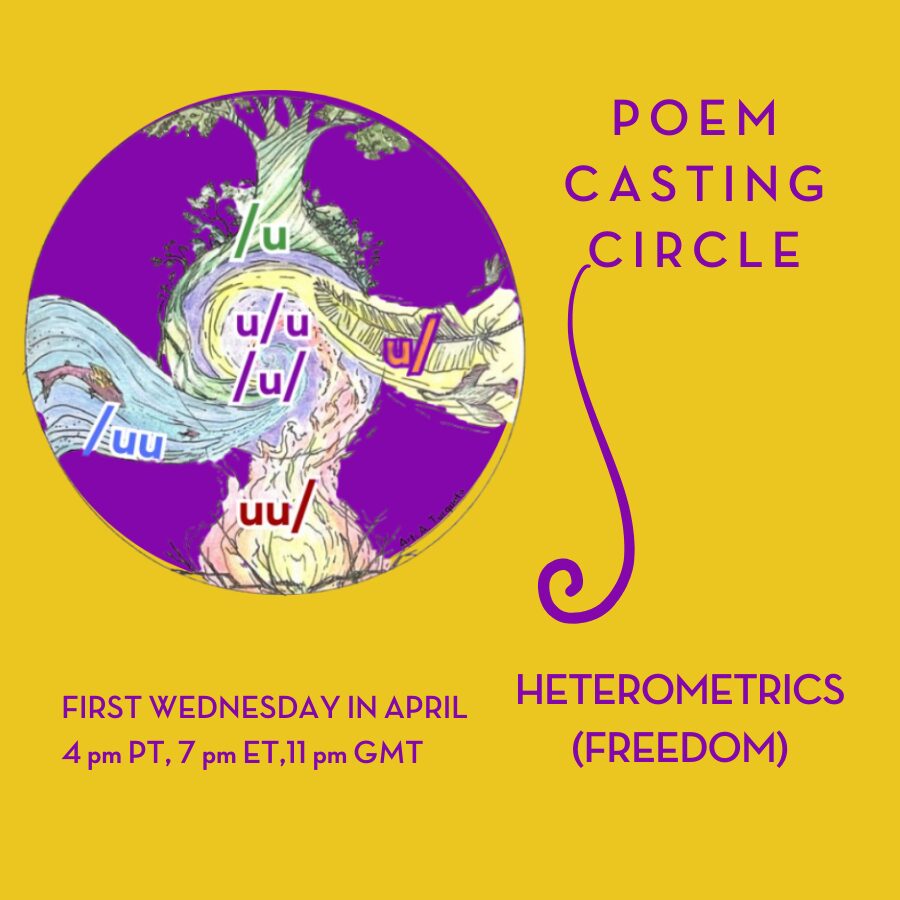
u u / Anapest: Meter of Fire and Passion
u / Iamb: Meter of Air and Clarity
/ u Trochee: meter of Earth and Strength
/ u u Dactyl: Meter of Water and Love
u / u Amphibrach: Meter of Matrix and Magic
/ u / Cretic, Meter of the Dark Goddess
Heterometrics: Metrical Strategy of Freedom
Dipodics: Metrical Strategy of Rooting
Cadences :Metrical Strategy of Transformation
BACKGROUND AND CONTEXT FOR THE 9 WAYS
People sometimes ask how these correspondences came about. If you’re curious, here’s the short version.
My Ph.D dissertation at Stanford University, published as The Ghost of Meter, focused on the intersection between poetic meters and meaning in poets over several centuries. Writing it convinced me to commit consciously to using diverse meters in my poetry. When I began writing poems for ritual use in earth spirituality circles around 1992, I immediately began experimenting with different meters to evoke different elements and spiritual qualities in my writing, ritual, and performance. After leaving university teaching in 2012, I soon extended this approach to my poetry teaching and healing workshops. Through repeated practice, trial and error —and, as time went on, discussion and exploration with hundreds of audience members, students, and artistic collaborators— I gradually refined & developed this system of correspondences.
In 2020, I began to travel extensively in India and Central America and to encounter meters in ceremonial use in oral-based, matriarchal cultures. I came to understand that across languages and cultures, Meters’ power to carry different spiritual and psychological qualities is well-recognized. Furthermore, the meaningful diversity of Meters plays a central role in ceremonies across cultures, just as I had come to use it in my own ritual practice. This realization came home to me most clearly when I encountered the 15000-year-old tradition of metrical correspondences in the Huichol culture in Mexico. I hope to travel soon to Scandinavia, The Phillipines, and Peru and to spend more time in Central Africa, exploring these uses of meter. I would also love to talk with you or others about ceremonial uses of meters in oral-based culture, so please feel free to reach out.
ENERGETIC TOOLS IN POEMCASTING
Below, you will find a new section with specific guidelines to enhance the energy of the Meter we will be using in this month’s Poemcasting.
FAQ: What if I feel different energies coming from a Meter than the ones you describe?
That is important for you to know, and certainly something you may want to bring into the journaling and discussion parts of our Circle. It will be welcome. The correspondences we use aren’t set in stone; we are all, including me, always exploring and learning new nuances of each Meter, so this would be interesting to discuss.
THE MOST IMPORTANT THING
In all this work, the most important tool is your own honest presence to the energy of the Meter of the Month, however it shows up for you. After all, underlying all of Meter’s aspects is our openness to channeling energies larger than ourselves.
Before the Circle, I invite you to practice staying open to yourself, kind to yourself, and curious about yourself.
Also, please enjoy reading (aloud!) the sample poems below. (If you’d like more, you’ll find others here and here). This pleasure will help invite the month’s Meter to dance with you !.
Yours in the Magic,
Annie
LINK TO ACCESS OUR MEETING PLACE
https://matrix.anniefinch.com
GUIDELINES For AnAPEST
Poemcasting in ANAPESTS, meter of fire...

WELCOME TO THE METER OF FIRE
This month’s Poemcasting Circle summons the energy of Anapestic meter, in the South direction of our Magic Circle. The South is the direction of desire, sexuality, and creativity, self-realization, ambition, and activism. May the fiery anapestic intentions set tonight honor Fire and invite the Will-ful power of Anapests into our poetry and all our words and worlds!
METER TOUCHSTONE
You are fire in the rock and the water and wind,
in the earth and the sun and the ocean and air.
— “Kettle Cove,” by A.F.
PREPARING FOR THE METER OF FIRE
You’re invited to prepare for our Circle in these ways:
Dress with something Red— also sexy, passionate, ambitious, daring, creative
Bring along something fiery and passionate for our virtual altar! Examples: red flowers, fire or light of any kind, powerful passionate creatures, totems, animals, or deities, anything involving sex, creativity, self-expression, or ambition.
Meditation/Intention/Dreaming-seed for the night before: “What is the hungry edge of my truest burning?”
ABOUT THE FACILITATOR
Annie Finch is a poet, speaker, teacher, and ritual performer dedicated to reweaving the skills of sacred poemcraft. She is the award-winning author of seven books of poetry including Spells, Eve, and a ritual verse play on abortion, Among the Goddesses. Her poetry has been a finalist for the National Poetry Series and the Yale Series of Younger Poets and received the Sarasvati Award from the Association for the Study of Women and Mythology. Annie holds a Ph.D from Stanford, has lectured at Harvard, Toronto, Delhi, and Oxford Universities, and authored influential works on poetic craft including A Formal Feeling Comes, The Body of Poetry, Villanelles, The Ghost of Meter, and A Poet’s Ear. Named the recipient of the 2010 Robert Fitzgerald Award for her lifetime contribution to the art and craft of poetic versification, she teaches widely and shares poetic and spiritual wisdom in her Poemcasting Circle and Formal Feeling Workshop at anniefinch.com.
See you soon!
For future Poemcastings, please see below!
Love,
Annie
REGISTration portal FOR FUTURE POEMCASTINGS.. .

For your convenience, here are links in case you want to reserve a spot for future poemcastings.
To register for the next full Poemcasting Circle Sequence (includes one session free), click on the register button.
To register for a single Poemcasting Circle, click on its image below.